
Uplighting is most effective when it reveals something worth seeing. Rather than placing colored fixtures randomly around a venue, the lighting plan should identify the walls, arches, columns, trees, drapery, and architectural details that deserve attention after sunset.
At Santa Barbara fall weddings, uplighting can add depth to Spanish-style courtyards, historic interiors, garden estates, vineyard properties, and covered reception spaces. The key is knowing what to illuminate, where to position the fixtures, and when another type of lighting would be more useful.
Start With the Surface, Not the Light Fixture
Uplighting works by directing light upward against a vertical or textured feature. The fixture itself is only one part of the effect. The surface receiving the light determines the visible color, beam shape, brightness, and amount of depth created.
Before choosing a fixture type or estimating quantities, planners should identify which venue features will remain visible from guest areas after dark. Lighting a few intentional surfaces usually produces a more refined result than placing identical fixtures around the entire property.
Look for Architectural Features With Depth
Santa Barbara venues often include architectural details that respond particularly well to uplighting. Arches, columns, recessed doorways, textured stucco, stone walls, fireplaces, balconies, and exposed beams develop highlights and shadows when illuminated from below.
A flat wall can receive a broad wash of light, but a surface with texture or depth creates a more dimensional result. For example, light placed at the base of a stucco arch can emphasize its curve, while a fixture directed toward a stone wall can reveal variations in the material that may disappear after sunset.
The lighting plan should prioritize features that contribute to the venue’s identity. At a Spanish-style courtyard, that may be a row of arches or a pale stucco façade. Inside a historic ballroom, it may be a fireplace, balcony, or decorative wall panel. These elements generally deserve more attention than an empty corner or service wall.
Consider Tent Draping and Interior Panels
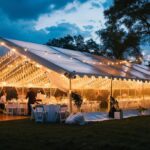
Inside a tent, uplighting can add depth to opaque sidewalls, draped panels, or fabric-lined perimeter sections. Light reflected against fabric can soften the interior and make the tent feel more visually complete after sunset.
The selected fabric affects the result. Pale draping generally reflects more light, while darker material absorbs it and may require a different brightness or fixture position. Pleated or gathered fabric can create additional shadows and texture.
Uplights should be coordinated with tent poles, entrances, tables, heaters, bars, and other equipment before installation. A fixture placed behind furniture may become blocked, while one located too close to a guest route may be disturbed during the reception.
The uplighting plan should support the tent design rather than replace the functional lighting needed over dining tables, service areas, and pathways.
Recognize When Uplighting Will Have Little Effect
Uplighting is not equally useful at every venue.
An open lawn, vineyard field, or coastal overlook may offer no nearby wall, tree, hedge, or structure for the light to reach. Placing fixtures around the perimeter of an empty area may create visible points of light without illuminating anything meaningful.
In these settings, overhead bistro lighting, chandeliers, pathway fixtures, table-level light, or targeted landscape lighting may be more effective.
The decision should begin with a simple question: What will each uplight illuminate? If a fixture does not have a clear surface or feature to reveal, it may not belong in the plan.
Walk the Venue at the Time Guests Will See It
A venue can appear detailed and well defined during an afternoon tour but look significantly flatter once natural light disappears. Walls recede, garden boundaries become less visible, and architectural details may be lost unless the permanent lighting already addresses them.
Whenever possible, the lighting plan should be based on an evening review or accurate nighttime photographs rather than daytime impressions alone.
Identify Which Areas Become Visually Flat After Dark
During an evening walkthrough, planners should note which spaces lose definition.
A courtyard may have beautiful arches that disappear into one pale wall after sunset. A garden reception may feel open and uncontained when the surrounding trees are no longer visible. A historic interior may have detailed columns and wall panels that receive little light from the existing chandeliers.
These visually flat areas are often stronger candidates for uplighting than spaces that are already illuminated adequately.
The goal is not to make every surface equally bright. Some darkness is useful because it creates contrast. Uplighting should restore depth to selected features while allowing secondary areas to remain quieter.
Determine the Main Guest Viewpoints
Lighting should be evaluated from where guests will actually spend time.
Important viewpoints may include:
-
Dining tables
-
The dance floor
-
The bar
-
Lounge seating
-
The main reception entrance
-
The couple’s table
-
The ceremony transition
-
Routes between indoor and outdoor areas
Dining tables
The dance floor
The bar
Lounge seating
The main reception entrance
The couple’s table
The ceremony transition
Routes between indoor and outdoor areas
A wall that is hidden behind the catering setup may not justify a full uplighting installation. In contrast, an architectural feature visible from the dining area, dance floor, and bar may deserve greater attention.
The plan should prioritize surfaces that appear in several important sightlines. This creates more impact with fewer fixtures and keeps the lighting connected to the guest experience.
Note Existing Venue Lighting
Permanent lighting should be documented before rental fixtures are added.
Existing sources may include:
-
Wall sconces
-
Chandeliers
-
Landscape lights
-
Ceiling fixtures
-
Pathway lights
-
Exterior building illumination
-
Spotlights
-
Fireplace lighting
-
Security or service lighting
Wall sconces
Chandeliers
Landscape lights
Ceiling fixtures
Pathway lights
Exterior building illumination
Spotlights
Fireplace lighting
Security or service lighting
Rental uplights should fill visual gaps rather than duplicate what the venue already provides.
A wall with evenly spaced sconces may need no additional fixtures. Another wall may have sufficient general brightness but lack emphasis on its arches or columns. In that case, selective uplighting can add depth without overwhelming the permanent design.
Existing fixtures also affect color. Warm sconces and cool uplights may produce an inconsistent appearance when used on the same surface.
Review the Setting Through Photography Angles
Uplighting often has its greatest visual value in the backgrounds of photographs.
The lighting team should review what appears behind:
-
The couple’s table
-
The dance floor
-
The bar
-
The band or DJ
-
The cake
-
Lounge furniture
-
Guest dining tables
-
Toasts and speeches
The couple’s table
The dance floor
The bar
The band or DJ
The cake
Lounge furniture
Guest dining tables
Toasts and speeches
A softly illuminated wall or row of arches can add separation between the subject and background. It can also prevent the surrounding venue from disappearing into darkness.
Photographers and videographers should be informed about the proposed fixture positions and color choices. Lights that point toward common camera locations may create glare, while highly saturated colors can alter skin tones and make editing more difficult.
Prioritize a Few High-Impact Venue Features
A controlled uplighting plan usually produces a more polished effect than a continuous row of lights around every available wall.
Santa Barbara venues often already have strong architecture and landscaping. The lighting should reveal those features selectively rather than covering the property in one repeated color.
Highlight the Wall Behind the Dance Floor
The area behind the dance floor remains visible during many of the reception’s most photographed moments. It may appear behind the first dance, parent dances, open dancing, speeches, and entertainment.
If the background includes arches, columns, woodwork, drapery, or textured stucco, uplighting can give it greater depth after sunset.
Fixtures should illuminate the feature rather than shine directly toward guests. Their positions should also account for speakers, entertainment equipment, dance-floor edges, and photographer movement.
A continuous wall wash may suit a broad flat surface, while individual fixtures can emphasize repeated columns or arches. The correct approach depends on the architecture and desired level of coverage.
Define the Couple’s Dining Area
A sweetheart or head table may need background emphasis, particularly when it sits against a plain wall, tent panel, hedge, or architectural feature.
Uplighting should be placed behind or to the sides of the dining area so that it creates separation without directing harsh light upward onto the couple’s faces.
The fixtures can reveal:
-
A stucco wall
-
An archway
-
Drapery
-
A hedge
-
A fireplace
-
A row of columns
-
A floral installation backdrop
A stucco wall
An archway
Drapery
A hedge
A fireplace
A row of columns
A floral installation backdrop
The color should also work with the linen, flowers, chairs, tabletop pieces, and surrounding lighting. A warm wall treatment may enrich an ivory or terracotta palette, while a strongly saturated color could compete with it.
Give the Bar a Visible Backdrop
The bar is often one of the most active areas of an evening reception. An illuminated wall, hedge, arch, or tent panel behind it can make the location easier to identify and give the setup greater visual weight.
The fixtures should remain outside the service area and should not interfere with back-bar storage, electrical equipment, beverage preparation, or guest queues.
Uplighting can also connect the bar visually to the rest of the reception. For example, the same warm tone used on courtyard arches may be repeated behind the bar, while the surrounding areas remain more neutral.
The bar itself may still require separate task lighting for staff. Uplighting should not be expected to provide sufficient illumination for beverage preparation.
Mark the Main Entrance Into the Reception
A selected set of uplights can help establish a clear arrival point after sunset.
Fixtures may be positioned near:
-
A courtyard entrance
-
An arched doorway
-
A building façade
-
A garden transition
-
A covered walkway
-
A tent entrance
-
A set of columns
A courtyard entrance
An arched doorway
A building façade
A garden transition
A covered walkway
A tent entrance
A set of columns
This treatment can guide guests from cocktails into dinner or from an outdoor ceremony into the reception.
The entrance should remain easy to navigate. Fixtures and cables must not narrow the route or create a trip hazard. Uplighting should visually identify the transition without placing equipment directly in the path.
Match the Placement to the Santa Barbara Venue Type
Different venue types require different approaches to uplighting. The same fixture spacing and color may look appropriate against a ballroom wall but ineffective on an open vineyard property.
The plan should respond to the materials, architecture, existing light, available power, guest layout, and installation restrictions of the specific location.
Historic Courtyards and Spanish-Style Buildings
Santa Barbara’s Spanish and Mediterranean architecture often includes pale stucco, arches, terracotta, dark wood, columns, fountains, and recessed doorways.
Uplighting can emphasize the depth of these features while preserving the warm character of the setting. Fixtures may be aligned with repeated arches, placed near columns, or directed toward textured walls.
The installation should remain restrained. Highly saturated color or excessive brightness can make a historic courtyard appear theatrical rather than refined.
Historic surfaces also require careful equipment planning. The venue may restrict tape, fasteners, cables, and fixture placement near protected tile, walls, fountains, or landscaping.
Clubs, Ballrooms, and Indoor Historic Venues
Indoor historic spaces may already have chandeliers or sconces that provide ambient light but leave the lower walls and architectural details visually flat.
Uplighting can reveal:
-
Columns
-
Fireplaces
-
Wall panels
-
Balconies
-
Recessed windows
-
Decorative plaster
-
Stage backdrops
Columns
Fireplaces
Wall panels
Balconies
Recessed windows
Decorative plaster
Stage backdrops
Fixtures should be positioned where chairs, bags, service carts, and guest movement will not block or disturb them.
The brightness should also be balanced against existing chandeliers and dining light. A wall should not appear dramatically brighter than the people and tables in front of it.
Garden and Estate Properties
Garden and estate weddings often use several connected areas, including lawns, terraces, patios, lounges, bars, and covered structures.
Uplighting can help define selected edges after sunset. Trees, hedges, exterior façades, pergolas, and garden walls can provide vertical features around the occupied space.
The plan should preserve areas of darkness. Lighting every tree and hedge equally can flatten the landscape and reduce the contrast that makes selected features stand out.
Garden conditions may also affect fixture stability, power access, and cable placement. Irrigation, roots, soft soil, and sloped terrain should be reviewed before installation.
Vineyard and Wine-Country Venues
In an open vineyard setting, uplighting works best when directed toward a building, mature tree, stone wall, covered structure, or reception tent.
Trying to uplight vineyard rows from ground level may have limited impact because the surface is irregular, distant, and difficult to illuminate consistently.
A more effective plan may highlight a winery façade, line selected trees near the reception, illuminate a stone wall, or add depth to tent draping. The vineyard and hills can remain visible during twilight and then recede naturally into the darker background.
This approach keeps the lighting concentrated around the actual event rather than dispersing fixtures across a large property.
Coastal and Open-Air Locations
Coastal properties may have broad views but few vertical surfaces. Uplighting alone cannot illuminate an ocean horizon or define a completely open lawn.
Useful targets may include:
-
Palms
-
Nearby buildings
-
Courtyard walls
-
Covered patios
-
Columns
-
Pergolas
-
Tent sidewalls
-
Landscaped boundaries
Palms
Nearby buildings
Courtyard walls
Covered patios
Columns
Pergolas
Tent sidewalls
Landscaped boundaries
The lighting plan should preserve the coastal view while giving the occupied event space enough depth after sunset.
Choose a Color That Supports the Venue Materials
Uplighting color should complement the architecture and design rather than become the dominant visual feature. Read more in Uplighting & Spotlighting Historic Architecture in Santa Barbara.
Warm, restrained tones often suit fall weddings because they work with stucco, wood, stone, terracotta, greenery, and neutral linens. More saturated colors can be introduced selectively when they support the palette and event atmosphere.
Use Warm Amber to Enrich Stucco and Wood
Soft amber or golden light can complement many Santa Barbara materials, including cream stucco, terracotta, dark wood, natural stone, and warm neutral fabrics.
The tone should remain controlled. Lighting that becomes strongly orange can distort flowers, linens, food, and skin tones.
Warm amber is particularly effective during dinner because it can create visual depth without introducing a noticeably artificial color. It also coordinates well with candlelight, bistro lighting, and chandeliers.
The fixture should still be tested against the actual surface. Pale stucco may reflect the color strongly, while dark wood may absorb much of it.
Use Neutral White to Reveal Texture Clearly
Warm white or neutral white uplighting may be more appropriate when the purpose is to reveal architectural texture without changing its color substantially.
This can work well on:
-
Stone walls
-
White columns
-
Sculptural features
-
Pale drapery
-
Historic plaster
-
Neutral tent panels
-
Textured façades
Stone walls
White columns
Sculptural features
Pale drapery
Historic plaster
Neutral tent panels
Textured façades
A white treatment can also support events with restrained palettes where amber or colored light would compete with the design.
The exact temperature should be coordinated with the venue’s permanent lighting. Mixing very cool white uplights with warm chandeliers may create an inconsistent appearance.
Reserve Deeper Colors for Selected Moments
Deeper colors such as burgundy, blush, blue, or purple may work in specific settings, particularly later in the reception.
A color shift may help distinguish dancing from dinner, although it should be planned rather than activated without coordination.
Saturated tones may be concentrated behind the dance floor, band, or entertainment area while dining and lounge spaces remain warmer and more neutral.
The event does not need to change color repeatedly. One controlled transition often feels more intentional than several rapidly rotating effects.
Avoid Colors That Distort Food and Skin Tones
Strong green, blue, purple, and red light can affect how people, food, flowers, and table settings appear.
These colors require particular caution near:
-
Dining tables
-
The couple’s table
-
The bar
-
Dessert displays
-
Lounge seating
-
Photography backdrops
Dining tables
The couple’s table
The bar
Dessert displays
Lounge seating
Photography backdrops
Highly saturated effects may suit the dance floor but feel less appropriate during dinner or speeches.
When the lighting reaches guest seating, the effect should be evaluated from eye level. A color that looks attractive on a wall may cast an unflattering reflection onto nearby faces. Read more in Wedding Lighting Rentals For Ceremonies in Camarillo.
Test the Color Against the Actual Surface
A fixture setting does not appear the same on every material. We cover this further in Transform Your Event: Mood Setting With Lighting Rentals.
Warm amber may look subtle on dark stone but strongly orange on white drapery. Purple may appear muted against wood but intense on pale stucco. Green light may blend into foliage while changing the appearance of nearby flowers.
Testing should account for:
-
Surface color
-
Texture
-
Distance from the fixture
-
Beam spread
-
Existing lighting
-
Nearby décor
-
Camera appearance
Surface color
Texture
Distance from the fixture
Beam spread
Existing lighting
Nearby décor
Camera appearance
When an in-person test is not possible, the team should review representative venue photographs and comparable material samples before approving the full treatment.
Decide Between Accent Lighting and a Full Wall Wash
Fixture quantity should be based on the intended effect rather than a universal formula. A few accent lights can reveal individual features, while repeated spacing may create a continuous wall wash. Both approaches can work, but they serve different purposes.
Use Accent Placement for Individual Features
Accent placement is appropriate when the venue contains separate architectural or landscape details.
Fixtures may be placed at:
-
Individual columns
-
Arches
-
Trees
-
Fireplaces
-
Doorways
-
Corners
-
Fountain surrounds
-
Drapery sections
Individual columns
Arches
Trees
Fireplaces
Doorways
Corners
Fountain surrounds
Drapery sections
This approach creates rhythm and contrast. It also allows the team to concentrate equipment where it will be noticed most.
Accent lights do not need to be spaced evenly around the venue if the architectural features themselves are irregular.
Use Repeated Spacing for a Continuous Surface
A broad ballroom wall, tent perimeter, or long courtyard façade may benefit from repeated fixtures that create a more continuous wash.
The spacing should be determined by the fixture output, beam angle, surface width, placement distance, and desired degree of overlap.
A full wash can help:
-
Define a ballroom perimeter
-
Complete a fabric-lined tent
-
Illuminate a long courtyard wall
-
Establish a consistent background behind dining tables
-
Connect repeated architectural bays
Define a ballroom perimeter
Complete a fabric-lined tent
Illuminate a long courtyard wall
Establish a consistent background behind dining tables
Connect repeated architectural bays
Fixtures should not be spaced according to one standard interval without testing how the beams meet on the actual surface.
Let Architectural Breaks Guide the Rhythm
Columns, arches, doors, wall panels, and structural bays provide natural points for fixture placement.
Aligning the lights with these features creates a more deliberate pattern than positioning them at arbitrary distances.
Prevent Bright Gaps and Uneven Beams
An installation should be reviewed for:
-
Dark gaps
-
Isolated hotspots
-
Different fixture brightness
-
Uneven beam heights
-
Inconsistent color
-
Light spilling onto guests
-
Fixtures blocked by furniture
Dark gaps
Isolated hotspots
Different fixture brightness
Uneven beam heights
Inconsistent color
Light spilling onto guests
Fixtures blocked by furniture
Adjusting the distance between the light and wall can change the beam width. Moving a fixture closer may create a narrower, stronger effect, while pulling it farther away may broaden the wash.
The final setup should be tested after tables, bars, lounges, and décor have been installed because these elements can obstruct the intended coverage.
Concentrate Equipment Where It Will Be Seen
A partial installation can be more effective than weak coverage around the entire venue.
When the plan does not require a full perimeter wash, fixtures can be concentrated behind:
-
The dance floor
-
The couple’s table
-
The bar
-
The reception entrance
-
A featured architectural wall
-
One or two landscape elements
The dance floor
The couple’s table
The bar
The reception entrance
A featured architectural wall
One or two landscape elements
This approach supports the areas guests see and photograph most often while allowing less important sections to remain darker.
Keep the Fixtures Discreet Within the Floor Plan
Guests should notice the illuminated surface before they notice the equipment creating the effect.
Fixture placement must be coordinated with furniture, décor, catering routes, power cables, guest traffic, and photography. Adding the lights after the floor plan has already been installed can lead to blocked beams and unsafe equipment locations.
Position Fixtures Close Enough to Reach the Surface
The distance between the fixture and surface affects the beam shape, width, and intensity.
A light placed very close to a wall may create a narrow vertical column. Moving it farther away may produce broader coverage but reduce intensity or increase light spill.
The correct position depends on:
-
Fixture output
-
Beam angle
-
Wall height
-
Desired coverage
-
Surface texture
-
Nearby furniture
-
Guest circulation
Fixture output
Beam angle
Wall height
Desired coverage
Surface texture
Nearby furniture
Guest circulation
Placement should be tested rather than estimated only from a floor plan.
Keep Lights Out of Guest Circulation
Uplights should not sit where guests, chairs, bags, service carts, or staff are likely to interfere with them.
High-risk areas may include:
-
Narrow walkways
-
Behind dining chairs
-
Near bar queues
-
Beside dance-floor entrances
-
At restroom routes
-
Near catering stations
-
Along lounge access points
Narrow walkways
Behind dining chairs
Near bar queues
Beside dance-floor entrances
At restroom routes
Near catering stations
Along lounge access points
The equipment should appear on the scaled event layout so it can be coordinated with the rest of the rentals.
Conceal Cables Without Creating Hazards
Plug-in uplights require a planned route to power.
Cables should not be stretched unprotected across guest paths or hidden in ways that make them difficult to inspect. Extension requirements, outlet locations, and cable-protection methods should be confirmed before the event.
The power plan must also account for other equipment, including entertainment, catering, heaters, tent lighting, and service fixtures.
Battery-operated units may reduce cable needs, but their operating duration and settings still need to support the complete event timeline.
Prevent Direct Glare Into Guest Seating
An uplight should point toward the selected surface rather than toward guests, the bar line, or common photography positions.
Direct glare can occur when fixtures sit too far from the wall, use a broad beam, or are angled outward.
The installation should be checked from seated eye level. A light that appears properly aimed while standing may still be visible and uncomfortable from a nearby dining chair.
Protect Historic and Finished Surfaces
Santa Barbara’s historic venues may have protected tile, wood, plaster, stone, or flooring.
The lighting plan should confirm:
-
Permitted fixture locations
-
Approved cable-protection methods
-
Restrictions on tape or fasteners
-
Rules for placing equipment near walls
-
Limits on staking or ground penetration
-
Access to outlets
-
Required floor protection
Permitted fixture locations
Approved cable-protection methods
Restrictions on tape or fasteners
Rules for placing equipment near walls
Limits on staking or ground penetration
Access to outlets
Required floor protection
Equipment should not be attached to or placed against historic materials without venue approval.
Balance Uplighting With the Rest of the Evening Lighting
Uplighting creates background depth, but it cannot provide all the illumination required for a wedding reception. Browse tents, dance floors, linens and more for your day on our wedding rentals in Ventura and Santa Barbara page.
Dining tables, faces, pathways, stairs, bars, catering stations, and dance floors may need separate lighting. A complete evening design layers these functions without allowing them to compete.
Let Bistro Lighting Define the Overhead Space
Bistro lighting can establish an overhead boundary above dining tables, dance floors, or open-air reception areas.
Uplighting serves a different purpose. It reveals vertical features and gives the background greater depth.
The two can work together when the colors and brightness are coordinated. Warm overhead bulbs paired with soft amber or neutral uplighting often create a cohesive result. Strongly colored walls beneath warm bistro strands may require more careful testing.
Keep Dining Tables and Faces Properly Illuminated
A brightly uplighted perimeter can make the center of a room or courtyard appear darker by comparison.
Dining areas need sufficient illumination for guests to see:
-
One another
-
Food
-
Menus
-
Place settings
-
Glassware
-
Steps and chair positions
One another
Food
Menus
Place settings
Glassware
Steps and chair positions
Chandeliers, tent lighting, bistro strands, candles, or other ambient sources may be required.
The lighting should remain balanced so the architecture does not appear dramatically brighter than the people and tables in front of it.
Use Candlelight as a Table-Level Layer
Candles can provide warmth and detail near the tabletop while uplighting creates visual depth in the background.
The candle plan should preserve enough open table space for glassware, plates, serving pieces, and guest comfort. Venue fire rules and enclosure requirements should also be confirmed.
Candlelight is decorative and atmospheric. It should not be treated as the only functional source for dining or circulation.
Add Chandeliers or Focused Fixtures Only Where Needed
Chandeliers, targeted spotlights, lamps, and other fixtures may be layered into the event when they serve a clear purpose.
A chandelier might define the dance floor or couple’s table. A focused light may reveal a cake display or band. Lamps may add a residential quality to a lounge.
The event does not need every lighting type in every area. Uplighting should establish the selected background features, while other fixtures address overhead, table-level, and functional needs.
Coordinate Uplighting With the Event Design Team
Lighting affects the appearance of flowers, linens, furniture, photography, food, and architectural materials.
The planner, venue, florist, photographer, videographer, rental team, and lighting team should work from the same floor plan and color direction before installation.
Share the Floral and Décor Focal Points
The lighting team should know which features are intended to remain visible after sunset.
These may include:
-
A floral installation
-
The couple’s table
-
The bar
-
A ceremony arch reused at the reception
-
Drapery
-
A fireplace
-
Lounge furniture
-
A cake display
-
Historic architectural details
A floral installation
The couple’s table
The bar
A ceremony arch reused at the reception
Drapery
A fireplace
Lounge furniture
A cake display
Historic architectural details
Fixtures can then be positioned to support these focal points rather than accidentally competing with or washing them out.
Review Linen and Tabletop Colors Under the Planned Light
Colored uplighting can alter the appearance of linens, flowers, glassware, and metallic finishes.
Warm amber may deepen ivory and terracotta tones, while purple or blue can make pale linens appear cooler. Metallic flatware and glassware may reflect the surrounding color more strongly than matte materials.
The design team should review how the selected uplighting interacts with the full palette after sunset.
Coordinate With Photography and Video
Photographers and videographers should know the fixture locations, colors, and planned transitions.
The team can identify:
-
Important camera angles
-
Potential glare
-
Highly saturated backgrounds
-
Areas of extreme contrast
-
Fixtures visible in wide shots
-
Color changes during key moments
Important camera angles
Potential glare
Highly saturated backgrounds
Areas of extreme contrast
Fixtures visible in wide shots
Color changes during key moments
A visually impressive wall may still create difficulties if the light shines toward the camera or produces an unflattering cast near the couple.
Confirm Changes Between Dinner and Dancing
If the fixtures can change color or brightness, the event team should decide when and why those changes will occur.
A possible sequence may include:
-
Warm white or amber during dinner
-
Slightly deeper color during dancing
-
Consistent architectural lighting throughout
-
Greater brightness only after sunset
Warm white or amber during dinner
Slightly deeper color during dancing
Consistent architectural lighting throughout
Greater brightness only after sunset
Rapid, sound-activated, or constantly changing effects may distract during dinner and speeches. Transitions should support the event schedule rather than occur automatically.
Frequently Asked Questions
Does Uplighting Work at an Outdoor Venue?
Yes, when the venue provides a suitable feature to illuminate.
Exterior walls, trees, hedges, columns, tent panels, pergolas, and covered structures may all support uplighting. The effect may be limited on a completely open lawn, vineyard field, or coastal overlook with no nearby vertical surface.
Outdoor fixture suitability and weather protection should be confirmed for the specific installation.
Are Battery Uplights Better Than Plug-In Fixtures?
Neither option is universally better.
Battery fixtures may be useful where cables would be difficult to manage or nearby power is unavailable. Plug-in fixtures may suit walls and tent panels located near reliable electrical access.
The event duration, operating settings, power conditions, and floor plan should guide the decision.
What Uplighting Color Works Best for a Fall Wedding?
Warm amber, soft gold, warm white, and controlled neutral tones often complement Santa Barbara’s stucco, wood, stone, terracotta, and garden settings.
The selected color should be tested against the actual surface and surrounding décor. Stronger colors may be introduced selectively during dancing when they support the event design.
Can Uplights Be Used at Historic Santa Barbara Venues?
They may be appropriate when the venue approves the fixture placement, cable routing, power access, and surface-protection methods.
The installation should not damage tile, walls, floors, landscaping, or architectural details. Venue restrictions should be confirmed before the floor plan and equipment order are finalized.
Does Ventura Rental Deliver and Set Up Uplighting?
Ventura Rental provides custom event proposals that can include delivery, professional setup, breakdown, and pickup for Santa Barbara events.
The specific installation requirements depend on the venue, fixture type, power access, equipment quantity, and event schedule.
Reveal the Venue Instead of Washing It in Color
Effective uplighting begins with the feature being illuminated, not the fixture. The strongest plans identify the walls, arches, columns, trees, drapery panels, and architectural details that contribute to the guest experience after sunset.
A few thoughtfully selected surfaces can create more depth than a continuous row of lights around every available perimeter. The venue should be reviewed from guest and photography viewpoints, and the color should support its materials rather than overpower them.
Fixture type, power access, cable management, guest circulation, surface restrictions, and outdoor conditions must also be resolved before installation. Uplighting should then be balanced with the overhead, table-level, pathway, and functional lighting needed throughout the event. You may also find How to Plan Outdoor Lighting for Fall Events in Santa Barbara helpful.
Ventura Rental Party & Events provides battery-operated and plug-in LED uplighting for Santa Barbara weddings and celebrations, along with coordinated event rentals and professional planning, delivery, setup, breakdown, and pickup. By developing the plan around the venue’s actual features, the lighting can reveal the setting instead of covering it in unnecessary color.